

Modern vehicles incorporate a range of technologies designed to prevent crashes or reduce their severity. These systems fall into two broad categories: active safety features that help avoid collisions and passive safety features that protect occupants when a crash occurs. For car buyers in 2026, understanding the most common and effective technologies is essential when evaluating new or used models.
Active Versus Passive Safety
Active systems continuously monitor the driving environment and intervene when necessary through warnings, braking or steering. Passive systems, such as seat belts, airbags, crumple zones and reinforced structures, manage crash forces once an impact begins. Both categories matter, yet advances in active safety have driven the largest recent reductions in certain types of collisions.
Automatic Emergency Braking and Forward Collision Warning
Automatic emergency braking ranks among the most impactful features available. Using cameras, radar or a combination of sensors, the system detects an imminent collision with a vehicle, pedestrian or cyclist ahead. It first warns the driver and, if no response occurs, applies the brakes to avoid or mitigate the impact. Many systems now operate effectively at both low and highway speeds.
Forward collision warning typically works in tandem with automatic emergency braking. It provides visual, audible or haptic alerts when a potential hazard is detected, giving the driver time to react before automatic intervention. Research consistently shows these technologies significantly reduce rear-end crashes.
Lane Support Technologies
Lane departure warning alerts the driver when the vehicle begins to drift out of its lane without a turn signal. Lane keeping assist goes further by applying gentle steering corrections to help guide the vehicle back into the lane. More advanced lane centering systems provide continuous steering support to keep the vehicle positioned in the middle of the lane, often working alongside adaptive cruise control.
These systems rely primarily on cameras that detect lane markings. Performance can decline when markings are faded, covered by snow or obscured by weather, underscoring the need for driver attention at all times.
Adaptive Cruise Control
Adaptive cruise control maintains a set speed while automatically adjusting to keep a safe following distance from the vehicle ahead. Sensors monitor traffic and can slow or accelerate the car as needed. More sophisticated versions handle stop-and-go traffic, bringing the vehicle to a complete stop and resuming when conditions allow.
This technology reduces driver fatigue on highways and in congested conditions. It does not replace the need to remain attentive or to respond to sudden cut-ins or complex situations outside the system’s operational design domain.
Blind Spot and Rear Cross-Traffic Systems
Blind spot monitoring uses radar sensors to detect vehicles in adjacent lanes that may not be visible in mirrors. When a vehicle is present and the driver signals a lane change, the system issues a warning, often through a light in the side mirror or an audible alert. Some systems add intervention capability, applying brakes or steering to help prevent a collision.
Rear cross-traffic alert performs a similar function when reversing. It detects vehicles approaching from the sides that may not be visible and warns the driver, helping reduce backing collisions in parking lots and driveways.
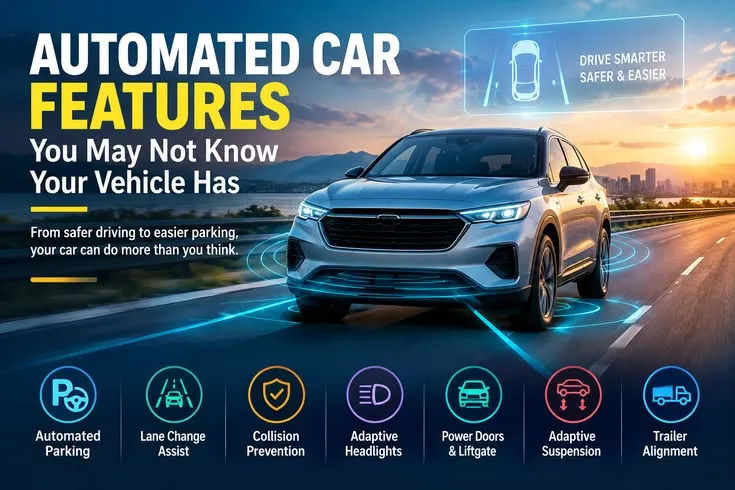
Driver Monitoring and Additional Systems
Driver monitoring systems use interior cameras to track the driver’s gaze, head position and attentiveness. They can issue warnings if signs of drowsiness or distraction appear. These systems are increasingly important as automation levels rise and are becoming more widely available.
Other established technologies include electronic stability control, which selectively brakes individual wheels to help maintain vehicle control during sudden maneuvers or on slippery surfaces, and tire pressure monitoring systems that alert drivers to underinflated tires. Automatic high beams adjust headlight settings based on oncoming traffic and ambient light.
Understanding Automation Levels
The SAE levels of driving automation provide a useful framework. Most current production vehicles operate at Level 0 (warnings only), Level 1 (assistance with either steering or speed) or Level 2 (simultaneous steering and speed control under driver supervision). Higher levels remain limited in availability and still require the driver to be ready to take control. No widely available passenger vehicle in 2026 is fully self-driving.
What Buyers Should Consider
When shopping, prioritize vehicles equipped with automatic emergency braking that includes pedestrian and cyclist detection, blind spot monitoring, lane keeping support and adaptive cruise control where relevant to driving needs. Many of these features are now standard or available across a wide range of trims. Checking independent safety ratings and understanding the specific capabilities and limitations of each system on a given model remains important.
Sensors and cameras require clear visibility to function optimally. Dirt, ice, heavy rain or damaged components can reduce performance. Regular maintenance and awareness of system status indicators help ensure reliability.
The Driver’s Ongoing Role
Even the most advanced assistance systems are designed to support, not replace, the driver. They reduce the likelihood and severity of certain crashes but cannot account for every scenario. Remaining attentive, understanding how the features operate and knowing when they may be limited form essential parts of safe driving.
Automotive safety technology continues to evolve, with increasing standardization of proven systems and ongoing refinement of detection and intervention capabilities. Buyers who understand these features can make more informed choices, selecting vehicles that offer meaningful protection for themselves, their passengers and other road users.
Read more – gloryhouseworld.com